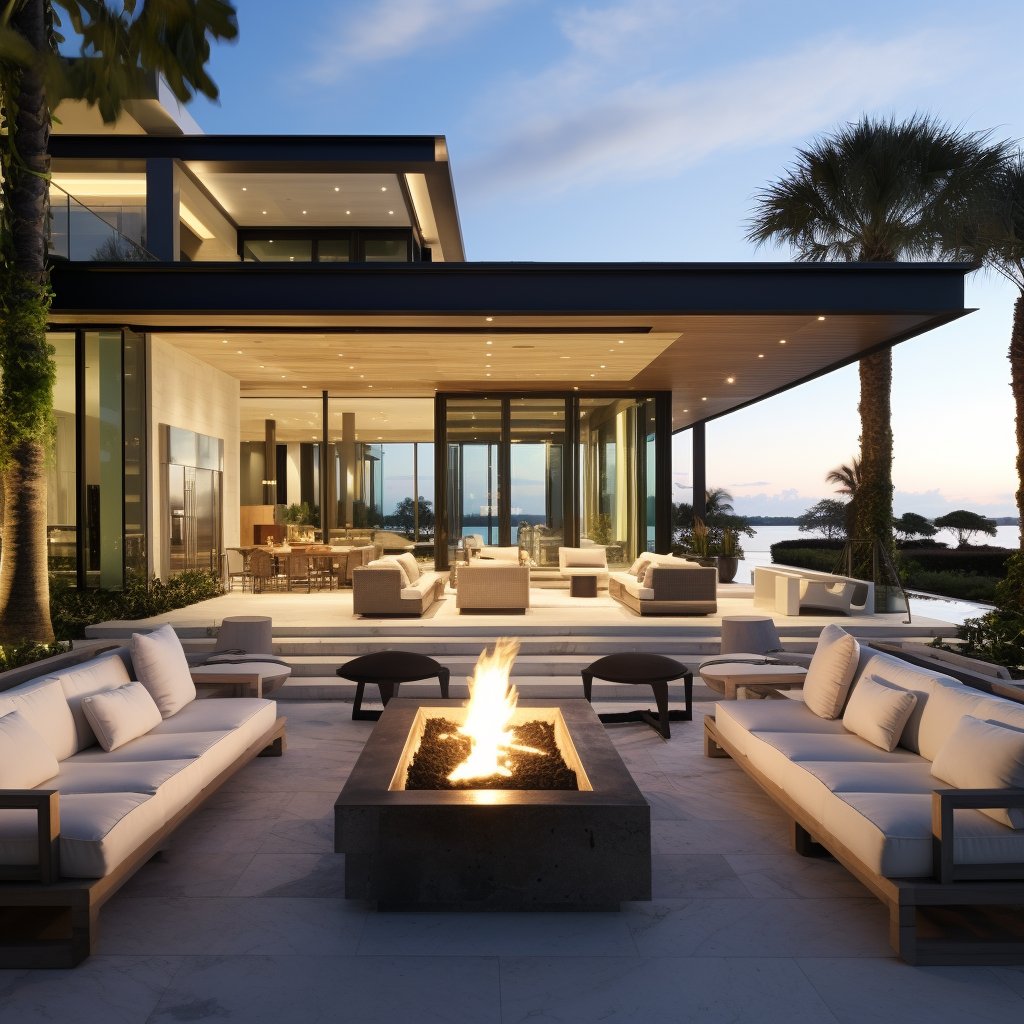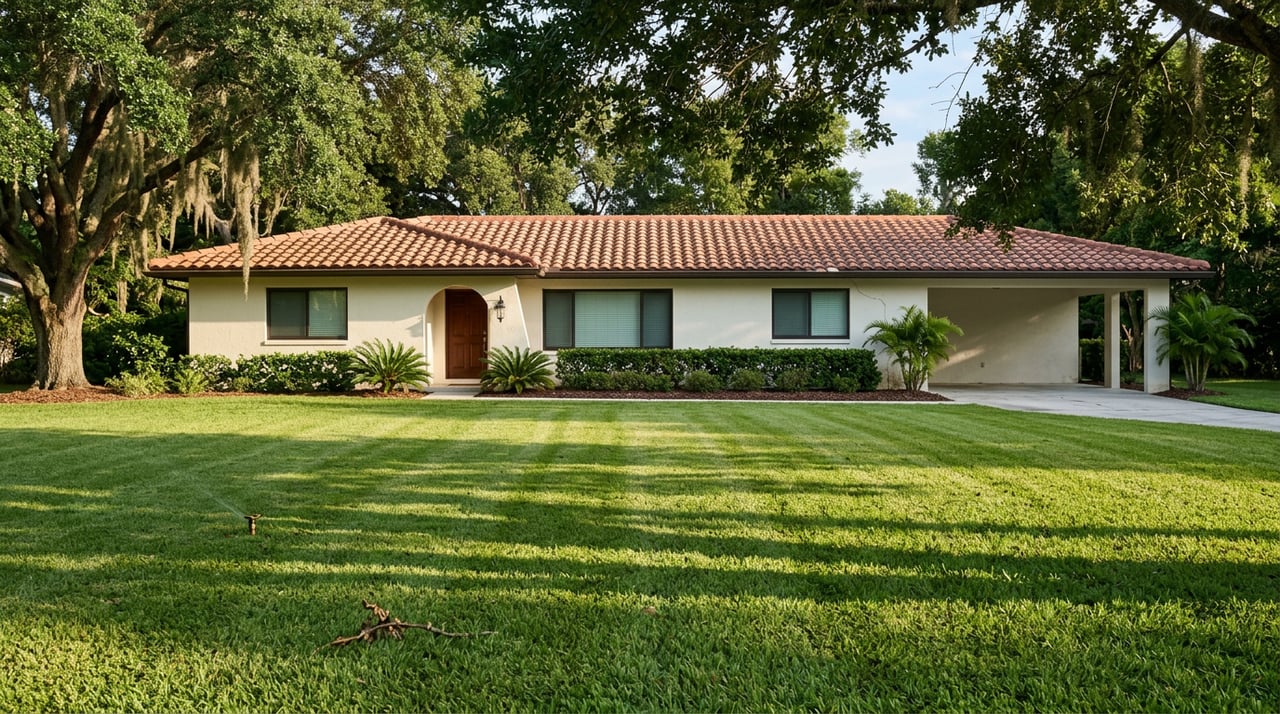
A buyer comes in with a $4 million budget. On the same Tuesday, two Pinecrest listings match the search. One is a renovated five-bedroom with a new roof, impact glass, and a finished pool deck. The other is a 1966 ranch with original terrazzo floors, jalousie windows, and a carport. Both are listed within $50,000 of each other. Neither is mispriced.
If that sounds like a contradiction, it is the entire Pinecrest market in one sentence. The portals are quoting a house price. The village is quoting a dirt price. Until a buyer separates the two, the median is not a benchmark. It is a blindfold.
The Portal Median Isn't Actually Wrong. It's Answering the Wrong Question.
Here is what the numbers look like in mid-2026, and here is why they disagree.
| Source | Snapshot | Reported Median | $/Sq Ft | Days on Market |
|---|---|---|---|---|
| MLS active listings | July 21, 2026 | $4.7M | $987 | — |
| Movoto list data | July 2026 | $3.14M | $811 | 39 |
| Zillow ZHVI | June 30, 2026 | $2.26M | — | 41 to pending |
| Realtor.com | December 2025 | $3.79M | $888 | — |
| Redfin | January 2026 | $4.225M | $910 | 96 to 116 |
The spread is not a data problem. It is a sampling problem. Active MLS listings skew toward larger, unsold estate product. Zillow's automated index averages every house in the ZIP, including small, older homes that rarely trade. Movoto and Realtor.com sit somewhere in the middle. All five numbers are accurate. None of them describe what a buyer will actually write an offer on.
The active Pinecrest inventory currently runs from $1.3 million to $22.5 million, with the average pulled well above the median by a handful of estate listings, and the typical active home built around 1997 asking roughly $987 per square foot. That range is not noise. It is the product.
What 88 Percent of Pinecrest Owners Already Know
The most important number in this market never shows up on a portal. Roughly 88% of single-family homes in Pinecrest carry a county land assessment higher than the assessment on the building sitting on that land. The median lot spans about 24,524 square feet. The median house on top of it is about 3,242 square feet. The median original year built is 1966, and more than half of properties show signals of renovation or replacement.
That distribution has a consequence. When a buyer writes an offer on a Pinecrest home, they are, in most cases, buying land with a structure attached. The structure is a depreciating asset with a finite useful life. The land is the compounding asset. Two houses at the same price often represent two completely different bets on which of those two components matters more.
The Zoning That Sets the Floor
Pinecrest's price behavior is not an accident of taste. It is written into the code. The Village's zoning ordinance carves the residential map into estate districts — EU-1C, EU-1, and EU-S — each with minimum lot standards that block subdivision. The county's parallel EU-1 estate district caps building coverage at 15% of net lot area on a one-acre minimum.
Translate that to the transaction. A builder who buys a tired 1966 ranch on an acre cannot cut it into two half-acre parcels and sell twice. The exit is one house, and the code decides how much house can go there. That constraint is why Pinecrest land values hold a floor other Miami-Dade submarkets do not. It is also why sellers who believe the "overprice and wait" playbook still works are watching their listings sit past 100 days while updated homes across the street go pending in six weeks.
North Pinecrest and South Pinecrest Trade Off the Same Median for Different Reasons
The village is not one market. It is two, and they move on different mechanisms.
North Pinecrest, closer to the commute corridors into Coral Gables, has been the fastest-moving pocket in 2026. The buyer profile skews toward the executive household leaving a smaller Coral Gables home to trade square footage for lawn. Demand there is a migration story.
South Pinecrest, bleeding into the Palmetto Bay edge, offers similar school access at a lower entry price. The buyer there is often a first-time Pinecrest buyer stretching for the address rather than an intra-village move-up. Demand there is a price-point story.
Both pockets share the same portal median. They do not share the same absorption. A buyer using a village-wide comp set to price an offer in either pocket is reading the wrong page.
The Teardown Math Buyers Are Actually Running
New construction in Pinecrest now routinely exceeds 5,000 to 10,000 square feet. Builders and end-user families writing land-plus-construction bets are running a specific arithmetic before they offer on an older home:
- Land basis. What has a comparable lot with a scrapeable house sold for in the last six months on this side of US-1?
- Demolition and site prep. Older homes with unpermitted additions carry hidden cost. Slab, septic if present, and mature-tree protections all price in.
- Build cost per square foot. Custom Tropical Modernism finishes — floor-to-ceiling glass, natural stone, indoor-outdoor transitions — are the current default and price accordingly.
- Coverage math. 15% coverage on a 24,500 square-foot lot yields a ground floor footprint of roughly 3,675 square feet. Second stories, setbacks, and pool placement all live inside that envelope.
- Time to a certificate of occupancy. Every month of construction is a month of carrying cost.
A finished-house buyer looking at the same listing is running a different equation entirely, comparing to renovated comps and weighting condition, roof age, impact windows, and mechanical systems. When those two buyers bid on the same property, the higher offer usually comes from whichever equation happens to yield a bigger number that week. That is why identical-looking listings can sell at very different prices, and why sellers who cannot articulate which buyer they are courting tend to leave money on the table.
What This Means for Your Offer
If a buyer is comparing Pinecrest against Coral Gables, Coconut Grove, or Palmetto Bay and using median list price as the anchor, three friction points show up during the transaction that portals do not warn about.
The first is the appraisal. A finished-home buyer financing at conventional loan-to-value ratios needs the appraisal to hit. In a market where the land often carries more value than the improvements, the appraisal comp set matters more than usual, and it is worth confirming that the lender's appraiser knows the local land-value pattern before the contract is signed.
The second is the inspection. A 1966 house with a 1990s remodel and a 2015 roof is three different building systems stacked on the same slab. Pinecrest inspections routinely surface polybutylene plumbing, cast-iron drain lines, panel obsolescence, and undocumented additions. None of those items kill a deal. All of them are negotiable if identified before the inspection period closes.
The third is the pricing dialogue with the seller. Roughly 83% of Pinecrest homes are homesteaded, and around a quarter have been held for more than 20 years. That ownership profile means the seller's basis is often a fraction of the current asking price, and the anchoring in negotiations can be emotional rather than analytical. Offers that show work — a land-value cross-check, a repair-adjusted valuation, a clear rationale — tend to survive counteroffers better than round-number bids.
Frequently Asked Questions
Is 2026 a buyer's market in Pinecrest? Closer to balanced than either extreme. Inventory is up roughly 10% year over year, days on market have stretched into the three-month range in several segments, and the "overprice and wait" seller strategy has stopped working. Well-priced, well-conditioned homes still move quickly. Everything else negotiates.
Does waterfront matter in Pinecrest? Less than it does in Coral Gables. Only 12 waterfront homes were listed among active single-family inventory as of the July 2026 MLS pull. The premium here is inland — privacy, canopy, and lot geometry — not dock access.
What makes a Pinecrest home a "land play" versus a "house play"? As a working rule of thumb, if the county land assessment is higher than the building assessment, the market will eventually price the property as land. That is the case for the large majority of the village. It does not mean every older home should be torn down. It does mean the seller and the buyer should both know which asset they are actually trading.
Should I wait for prices to drop? Local forecasts point to modest appreciation of 3% to 5% into the back half of 2026, not a correction. The structural land constraint that supports Pinecrest values has not changed. Waiting for a discount that the zoning code will not allow is a strategy with a long tail.
Pinecrest rewards buyers who read the property, not the portal. If you are weighing an offer, thinking about listing, or trying to figure out whether the house you like is really a house or really a lot, Adrian Gonzalez at The Firm A Real Estate Brokerage can walk the block with you and pull the land-value comps before you sign. Request your free home valuation and start the conversation with a number that reflects what your address is actually worth.